admin
admin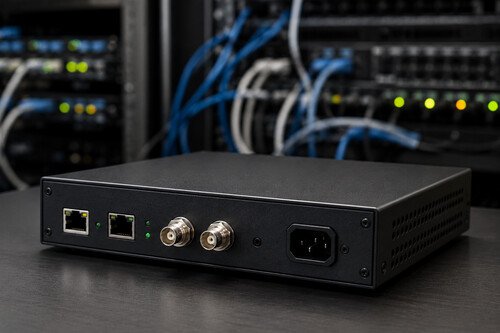
Modern television distribution systems often combine network-based video sources with traditional coaxial cable infrastructure. Many hotels, hospitals, campuses, residential buildings, and commercial facilities already have CATV networks installed, but they increasingly rely on IP-based content such as IPTV streams, digital signage, camera feeds, internal information channels, or live video from encoders. IP to CATV edge modulators make it possible to connect these two environments efficiently. An IP to CATV edge modulator is a device that receives video streams over an IP network and converts them into RF television channels for distribution through a CATV system. Thanks to this process, content managed on a digital network can be viewed on standard televisions through their built-in tuners, without the need for a separate receiver or media player at every screen. This article explains what IP to CATV edge modulators are, how they work, where they are used, and why they are valuable in modern video distribution systems. It also discusses their main advantages, limitations, and the key technical factors that should be considered before installation.
What Are IP to CATV Edge Modulators?
IP to CATV edge modulators are professional devices used to convert video streams delivered over an IP network into television channels that can be distributed through a CATV coaxial cable system. In simple terms, they take digital video content from a network source and transform it into RF television signals that can be received by TVs through their built-in tuners. These devices are commonly used in hotels, hospitals, residential buildings, educational campuses, corporate facilities, sports venues, and other environments where many televisions need to receive centrally managed TV channels. Instead of placing a separate media player or decoder next to every TV, an IP to CATV edge modulator allows multiple IP streams to be converted into standard TV channels and distributed through existing coaxial infrastructure.
Understanding the Basic Concept
To understand how IP to CATV edge modulators work, it is useful to separate the term into three parts: IP, CATV, and edge modulation. IP stands for Internet Protocol. In video systems, IP is used to transport digital video streams over a computer network. These streams may come from encoders, servers, IPTV systems, satellite receivers, media gateways, cameras, or other network-based sources. CATV stands for Community Antenna Television or Cable Television. It refers to a television distribution system that uses coaxial cable to deliver multiple TV channels to many receivers. CATV systems are still widely used in hotels, apartment buildings, commercial properties, healthcare facilities, and public venues. An edge modulator is a device placed near the “edge” of a distribution system. Its role is to receive digital content from one side, usually an IP network, and output television channels on the other side, usually as RF signals for coaxial distribution. An IP to CATV edge modulator therefore acts as a bridge between modern network video systems and traditional television distribution networks.
How IP to CATV Edge Modulators Work
The operating principle of an IP to CATV edge modulator is based on signal conversion. The device receives one or more IP video streams through an Ethernet connection. These streams may use common transport methods such as multicast or unicast, depending on the system design. After receiving the streams, the modulator processes the video and audio data. In many cases, the incoming streams are already encoded in a digital video format. The device organizes these streams into transport streams, assigns channel information, and modulates them onto RF frequencies suitable for CATV distribution. The final output is delivered through a coaxial RF port. From there, the signal can be connected to a building’s coaxial network, combined with other RF signals, amplified, split, and sent to many televisions. On the receiving end, users do not need a special IPTV box if the TV tuner supports the output standard. The television simply scans for available channels and displays the IP-originated content as normal TV channels.
Why These Devices Are Important
IP video systems and CATV systems are often used in the same buildings, but they are based on different technologies. IP systems use network cables, switches, routers, and digital stream management. CATV systems use coaxial cable and RF channel distribution. Many buildings already have coaxial cabling installed. Replacing this infrastructure with a fully IP-based system can be expensive, time-consuming, and disruptive. IP to CATV edge modulators solve this problem by allowing modern IP video sources to be delivered through existing coaxial networks. This makes them especially valuable in retrofit projects. A hotel, hospital, or residential complex may want to upgrade its content sources, add digital signage channels, distribute internal information, or integrate IPTV streams without replacing every television or rewiring the building. By converting IP streams into CATV channels, edge modulators combine the flexibility of IP content management with the simplicity of traditional TV reception.
Common Applications
One of the most common uses of IP to CATV edge modulators is in hospitality systems. Hotels often need to distribute television channels, welcome screens, promotional content, local information, and event channels to guest rooms. With an edge modulator, IP-based content can be converted into RF channels and delivered to every room through existing coaxial cable. Hospitals and healthcare facilities also use this technology. Patient rooms often have televisions connected to a central coaxial system. IP to CATV modulation allows hospital information channels, educational videos, entertainment feeds, and internal communications to be distributed efficiently. In residential buildings, these devices may be used to distribute shared channels, security camera feeds, community announcements, or local content. In student housing and campuses, they can support educational channels, lecture broadcasts, event coverage, and campus information services. Corporate buildings and conference centers may use IP to CATV edge modulators for internal communication channels, training content, live presentations, or digital signage feeds. Sports venues and arenas may use them to distribute live camera feeds, scoreboards, advertising, or event information to TVs located throughout the facility.
IP Video Sources
An IP to CATV edge modulator can receive video from many types of IP sources. These may include IPTV headend systems, video encoders, streaming servers, satellite-to-IP gateways, camera encoders, media servers, or digital signage systems. For example, a live event camera may be connected to an encoder that creates an IP stream. The edge modulator receives this stream and converts it into a CATV channel. Viewers across the building can then watch the live feed by selecting the assigned channel on a television. Another example is a central media server that sends scheduled video content over the network. The modulator can convert these streams into multiple RF channels, each carrying different content. This flexibility is one of the major strengths of IP-based input. Content can be generated, changed, scheduled, or managed centrally before being converted into standard television channels.
Output to CATV Networks
The output side of an IP to CATV edge modulator is designed for coaxial television distribution. The device creates RF channels that can be inserted into a CATV system. These channels are usually assigned specific frequencies so they do not interfere with existing services. A CATV network may carry many channels at once. These can include broadcast channels, satellite channels, locally generated channels, information channels, and IP-converted channels. The edge modulator must be configured so that its output fits properly into the channel plan. In larger systems, the RF output may pass through combiners, amplifiers, splitters, taps, and distribution panels. Proper signal level management is important. If the RF signal is too weak, televisions may not tune reliably. If it is too strong, distortion or interference may occur. For this reason, installation usually requires careful planning, especially in large buildings with many outlets.
Digital Modulation Standards
IP to CATV edge modulators can support different digital television modulation standards depending on the region and system requirements. The output format must match the tuners used in the televisions. Some systems use cable-style digital modulation, while others may use terrestrial-style modulation. The correct choice depends on the local TV standard, the existing CATV infrastructure, and the receiving devices. This compatibility is critical. If the modulator outputs a signal format that the televisions cannot decode, the channels will not appear during scanning or will not display correctly. Before selecting or installing an edge modulator, the technical standard of the TV network should be confirmed. The channel configuration may also include service names, program numbers, network identifiers, and other digital channel information. These settings help televisions recognize, store, and organize the channels correctly.
Advantages of IP to CATV Edge Modulators
The main advantage of IP to CATV edge modulators is that they allow modern IP video content to be distributed through existing coaxial cable. This can significantly reduce installation costs compared with replacing the entire television distribution system. Another advantage is centralized control. Content sources can be managed from a network location, while viewers continue to use standard televisions. This is useful in hotels, hospitals, campuses, and commercial buildings where content must be updated regularly. These devices also simplify the viewing experience. Users do not need to select HDMI inputs, operate external receivers, or use separate streaming boxes. They simply choose a TV channel. IP to CATV edge modulators are also scalable. Multiple IP streams can be converted into multiple TV channels. This allows a system operator to add local channels, information feeds, camera views, or event broadcasts as needed. They also help integrate different technologies. A facility can use IP-based content creation and management while keeping the reliability and familiarity of coaxial TV distribution.
Limitations and Challenges
Although IP to CATV edge modulators are highly useful, they also have limitations. The first challenge is compatibility. The input stream format, video codec, audio codec, resolution, bitrate, and transport method must be supported by the modulator. If an incoming IP stream uses an unsupported format, the device may not process it correctly. In some systems, additional encoding or transcoding equipment may be required. The second challenge is network stability. Since the input is IP-based, the quality of the network affects the reliability of the video. Packet loss, incorrect multicast configuration, overloaded switches, or unstable sources can cause video errors. Another challenge is RF planning. The output channels must be assigned carefully to avoid interference with existing channels. In large CATV systems, signal levels must also be balanced properly. There may also be a delay between the IP source and the TV output. This delay is usually acceptable for information channels, entertainment, signage, or general viewing, but it may matter in time-sensitive applications such as live event monitoring.
Difference Between IPTV and IP to CATV Modulation
IPTV and IP to CATV modulation are related, but they are not the same. In a pure IPTV system, video streams are delivered directly over a data network to IPTV receivers, smart TVs, or set-top boxes. Each display must be capable of receiving and decoding IP streams. In an IP to CATV system, the IP streams are converted into RF television channels before reaching the viewer. The final distribution happens over coaxial cable, and the television receives the content through its tuner. The advantage of IPTV is flexibility and two-way communication. It can support interactive services, on-demand content, and individual streams for different users. The advantage of IP to CATV modulation is simplicity and compatibility with existing coaxial systems. Many facilities choose IP to CATV modulation when they want the benefits of IP content sources but do not want to install or maintain IPTV receivers at every television.
Installation Considerations
Before installing an IP to CATV edge modulator, several factors should be reviewed. The first is the number of IP streams that need to be converted. Some systems require only one or two channels, while others may need many. The second factor is input compatibility. The video format, resolution, bitrate, transport protocol, and audio format should be checked. The modulator must be able to receive and process the streams correctly. The third factor is output standard. The RF modulation format must match the televisions and the local CATV system. The channel frequencies should be selected carefully to avoid conflicts. The fourth factor is network design. If multicast streams are used, network switches must be configured correctly. Poor network design can lead to stream loss, freezing, or instability. The fifth factor is RF distribution. Cable quality, splitters, amplifiers, and existing signal levels should be evaluated. A clean and properly balanced coaxial network is essential for reliable channel reception.
Content Management and Channel Planning
A well-designed IP to CATV system depends on good channel planning. Each output channel should have a clear purpose and a unique frequency. Channel names should be logical so users can identify them easily. For example, a hotel may create separate channels for guest information, restaurant promotions, conference schedules, local attractions, and live events. A hospital may create channels for patient education, facility information, relaxation content, and internal announcements. Because the content originates from IP sources, it can often be updated centrally. This makes the system useful for facilities that need to change messages, schedules, or videos frequently.
Conclusion
IP to CATV edge modulators are important devices that connect IP-based video systems with traditional coaxial television networks. They receive digital video streams over an Ethernet network and convert them into RF channels that can be distributed through CATV infrastructure. They are especially useful in hotels, hospitals, campuses, residential buildings, corporate facilities, sports venues, and other large installations where many televisions need access to centrally managed content. Their main advantage is the ability to use modern IP video sources while preserving existing coaxial cabling and standard TV viewing. When properly configured, an IP to CATV edge modulator provides a practical, scalable, and cost-effective way to distribute digital content across a building. However, successful installation requires attention to input stream compatibility, network performance, RF channel planning, signal levels, and television tuner support. In environments where IP content and coaxial distribution must work together, IP to CATV edge modulators offer a reliable bridge between two different generations of video technology.